
How Hybrid AI Workflows Reinvented Back-Office Operations for a Fintech Firm
A practical breakdown of AI-driven back-office outsourcing for fintech teams looking to improve research speed, data accuracy, and operational efficiency

The fintech advisory firm wasn’t drowning, but it was definitely dragging.
Their analysts were sharp, their reports were solid, and clients appreciated the insights.
But behind the scenes, something else was happening — the small, routine tasks were piling up faster than the team could clear them.
Client data needed formatting.
Market reports needed summarization.
Weekly deliverables needed packaging.
Email threads needed sorting.
None of this was “hard work,” but all of it was time-consuming work — the kind that slowly eats away at expertise.
That’s when they came across the Expert360.ai LinkedIn page. They reached out to explore whether we could help.
Where it Started: Not With Automation, But With Observation
Instead of jumping in with AI immediately, we first observed their workflows.
Within two weeks, patterns became clear:
Analysts spent 20–25% of their time cleaning and structuring client data.
Partners wasted hours reviewing drafts that needed basic polishing
Important deliverables were often delayed because someone was stuck preparing background research.
None of these were strategic tasks.
All of them were bottlenecks.
Step 1: Rebuilding Their Research Backbone (Using Perplexity + ChatGPT + AlphaSense)
The firm’s weekly insight reports required:
Scanning regulatory updates
Summarizing industry news
Extracting relevant implications for clients
Earlier, this took 6–7 hours per analyst per week.
We redesigned this workflow around a hybrid model:
Perplexity for quick regulatory scanning
AlphaSense for deeper industry document extraction
ChatGPT for synthesis, draft structuring, and highlight identification
Human analysts for validation, interpretation, and final client relevance mapping
The result?
Weekly research became a 2-hour task instead of a full workday.
And importantly — quality didn’t drop.
Analysts were spending more time on interpretation, not collection.
Step 2: Turning Raw Client Data Into Usable Assets (Using Claude + Excel + Python Scripts)
The firm receives raw financial data from multiple clients:
CSVs
Screenshots
PDFs
Unstructured monthly reports
Our data assistants built a pipeline where:
Claude extracted structured tables from PDFs and messy documents
Python scripts cleaned repeating fields, tagged anomalies, and standardized formats
Excel templates ensured everything landed in a uniform structure
A human data specialist verified edge cases and unusual patterns
This wasn’t fully automated — and it wasn’t meant to be.
The hybrid workflow cut processing time by 60% and made data usable on the same day it arrived.
Step 3: Content Polishing and Deliverable Packaging (Using Grammarly + GPT-4 + Notion)
Before working with us, partners spent a surprising amount of time:
Reformatting pitch decks
Cleaning grammar
Rewriting sections for clarity
Organizing insights into Notion pages
With the new workflow:
GPT-4 created drafts and rewrote sections based on tone guidelines
Grammarly Business ensured compliance-grade writing quality
Notion AI organized content into briefs, summaries, and deck outlines
A human project manager finalized and approved everything before delivery
This reduced partner review time by 40% and allowed them to focus on client discussions instead of formatting slides.
Step 4: A Small Team That Became Their 30% Engine
Over time, the firm built a dedicated Expert360.ai pod:
1 research assistant
1 data/ops assistant
1 content specialist
1 workflow manager
1 AI tools engineer (shared)
This group quietly absorbed:
Weekly research
First-level data cleaning
Report drafting
Operational coordination
Document preparation
Inbox triage & client prep
Not dramatic, not flashy — but consistent.
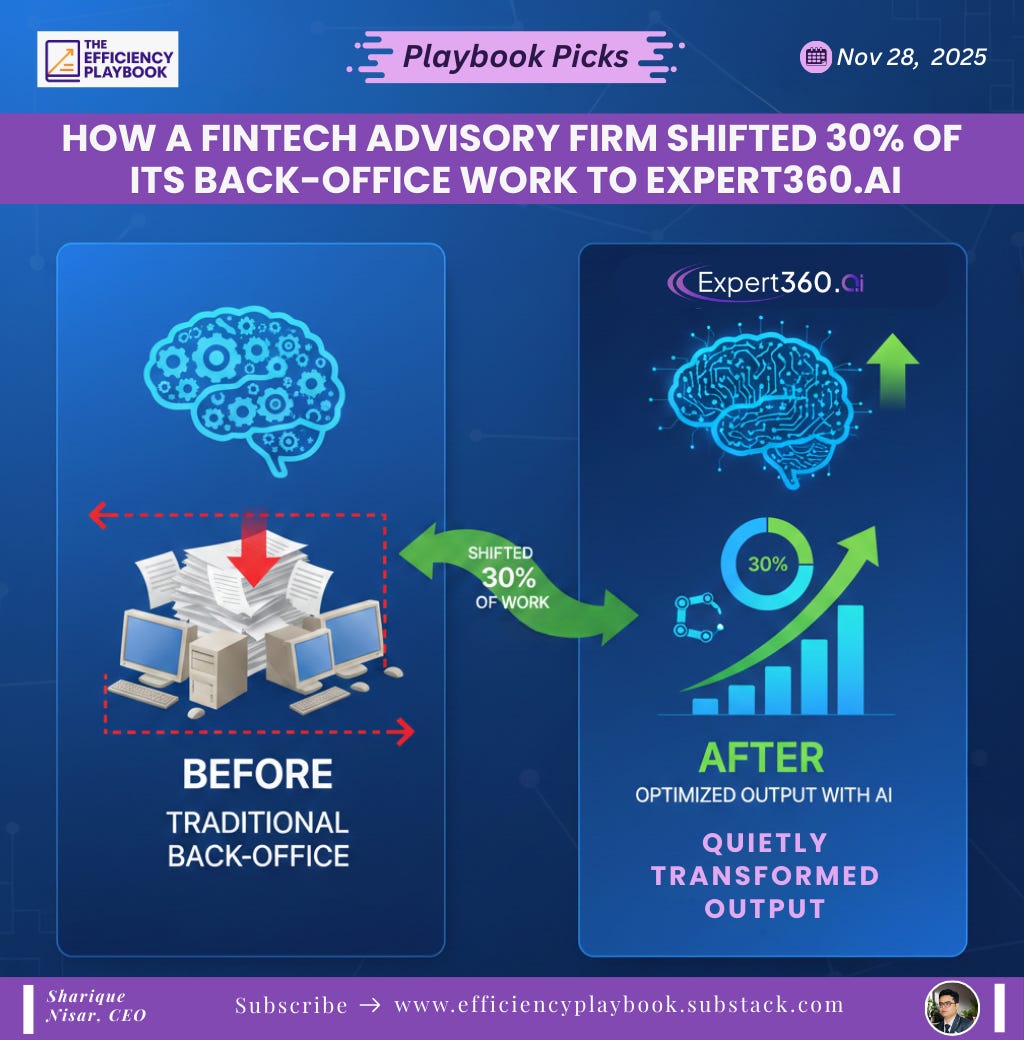
By month three, 30% of their back-office load was handled smoothly by this hybrid AI-powered pod.
The Before vs After: A Realistic Comparison
Before: No AI
Analysts overloaded with repetitive tasks
Data standardization slow and manual
Research backlog every week
Partners reviewing drafts late at night
Delays in client deliverables due to bottlenecks
Zero documentation of workflows
After: AI + Human Integration
Analysts focused on high-value thinking
Data pipelines structured and partially automated
Weekly research done in hours, not days
Deliverables polished before they reach partners
Workflow manager ensures consistency
Tools like Perplexity, Claude, AlphaSense, GPT-4, Grammarly, Python scripts run quietly in the background
Back-office load reduced by 30% without hiring more staff
The Most Surprising Impact
Not productivity.
Predictability.
The firm finally operated on a smooth weekly rhythm, with:
No missing Monday research briefs
No last-minute data crunching
No partner scrambling to clean a deck before a client call
No analyst burnout from grunt work
The team didn’t feel replaced.
They felt relieved.
Final takeaway
This wasn’t a story of AI replacing a team.
It was a story of removing friction so the team could finally operate at the level they were trained for.
By integrating AI tools with human oversight — and by shifting 30% of repetitive work to Expert360.ai — the fintech advisory firm didn’t just improve output.
They improved the quality of thinking behind every deliverable.