
India’s Quiet Power Move: Why Global SMBs Should Outsource Now
A deep dive into how India’s data-centre tax holiday reshapes outsourcing, remote work, and execution strategy for global businesses

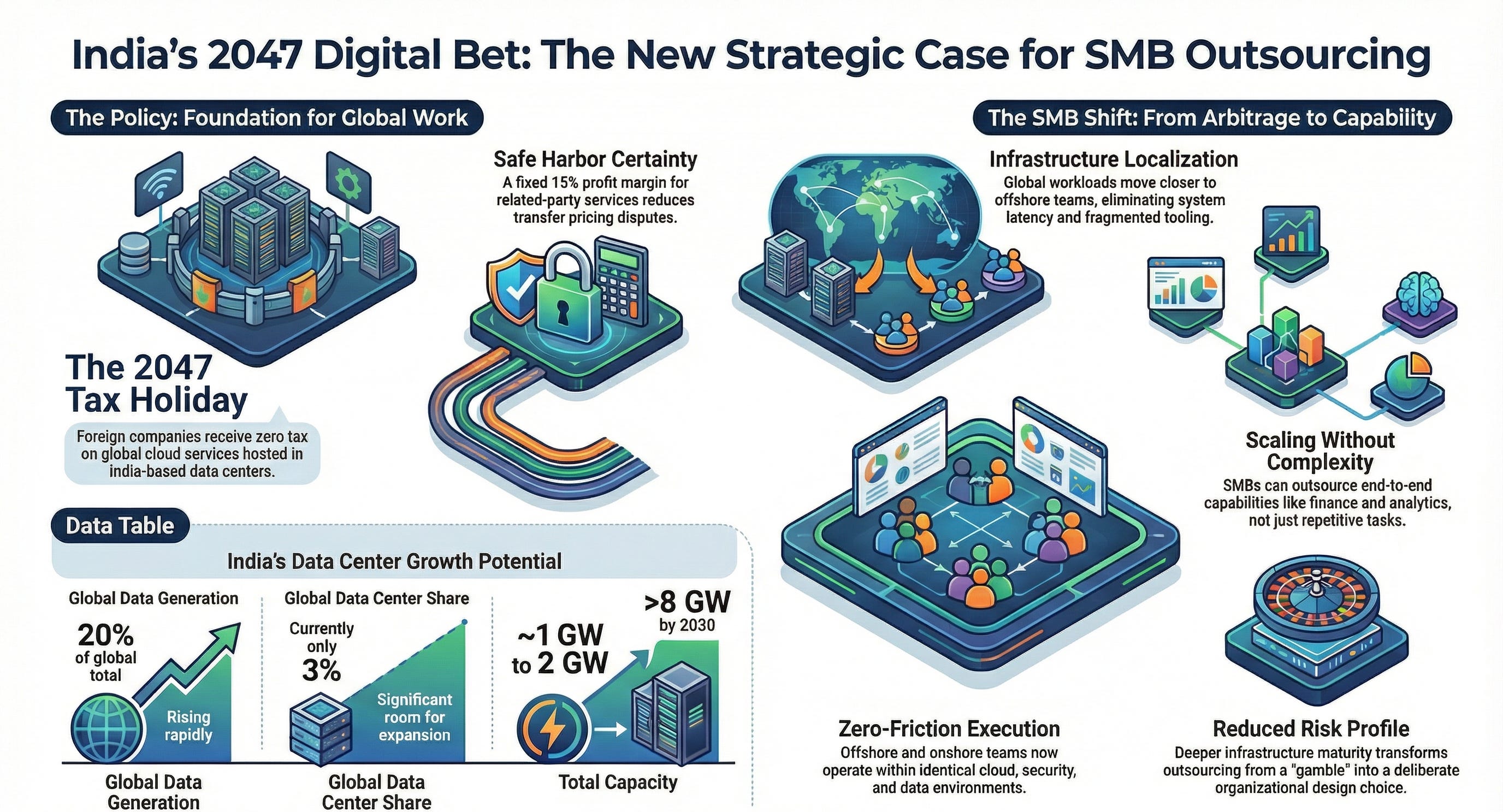
In this week’s Playbook Kickoff, we briefly mentioned a policy announcement that, at first glance, appeared to be aimed squarely at Big Tech and hyperscalers: foreign companies will receive a long tax holiday, potentially running until 2047, for hosting global cloud services from data centres located in India. It was framed as an infrastructure and investment story, and most early commentary stayed within that lens.
But policies like this rarely stop at their stated audience. When a country makes a multi-decade bet on digital infrastructure, it quietly reshapes how global work is executed, where value is created, and which operating models become viable. That is why this announcement deserves attention not only from cloud giants and policymakers, but from small and mid-sized businesses across the US, UK, Europe, Australia, and beyond—especially those that already outsource work, or are considering doing so.
This article is a deeper look at what this move actually signals, and why it matters for outsourcing, remote work, and offshore execution decisions.
Beyond Big Tech: what the policy really changes
At its core, this policy is about attracting global workloads into India. By offering long-term tax certainty to foreign companies that serve international customers using India-based data centres, the government is sending a clear message: India wants to be a foundational layer of the global digital economy, not just a consumer market or an IT services exporter.
For years, India’s role in the global economy was defined by talent exports—engineers, analysts, and operators delivering work remotely. What is changing now is that the infrastructure those people depend on is moving closer to them. Compute, storage, analytics platforms, AI tools, and collaboration systems are increasingly being hosted and operated locally, at global scale.
This matters because outsourcing friction was never only about people. It was about distance from systems, data, and decision-making environments. When offshore teams had to work around latency, access restrictions, fragmented tooling, or compliance uncertainty, execution suffered—not dramatically, but persistently. Those small inefficiencies added up.
As global cloud infrastructure consolidates in India, those frictions begin to disappear. Offshore teams can now work inside the same environments as onshore teams, using the same tools, accessing the same data, and operating under the same security frameworks. The practical distance between headquarters and offshore execution shrinks, even if the geography does not.
Why this matters specifically for global SMBs
Large enterprises already operate global delivery models. They have internal platforms, captive centres, and long-established vendor ecosystems. For them, this policy improves margins and scale efficiency, but it does not fundamentally change how they work.
For SMBs, the impact is far more significant.
Most small and mid-sized businesses face a constant tension between growth and capacity. Hiring senior talent locally is expensive, slow, and increasingly uncertain. At the same time, founders and leadership teams are pulled into operational work that distracts from strategy, sales, and product development. Outsourcing is often considered—but usually late, and often defensively.
What this policy environment changes is the risk profile of outsourcing. With better infrastructure, deeper talent exposure to modern tools, and stronger ecosystem maturity, outsourcing becomes less of a gamble and more of a design choice. It allows SMBs to scale execution without scaling organizational complexity.
This is particularly relevant for functions that are essential but non-core: finance and accounting operations, marketing execution, research, analytics, data handling, and administrative workflows. These areas require consistency, accuracy, and speed—but not necessarily proximity to the founder’s desk.
When these functions are outsourced well, they free leadership attention without compromising quality. When they are kept in-house too long, they quietly tax growth.
The evolution from cost arbitrage to capability leverage
Outsourcing to India has long been associated with cost savings, and that advantage still exists. However, focusing only on cost misses the more important shift underway.
As infrastructure and tooling improve, offshore teams are no longer limited to transactional or repetitive work. They can handle integrated workflows, interact directly with core systems, and support decision-making functions rather than just execution. This allows SMBs to outsource capability, not just labor.
For example, finance teams offshore can now manage end-to-end accounting operations using the same cloud-based ERP and reporting tools as the onshore team. Marketing support teams can execute campaigns, analyze performance data, and iterate quickly without delays caused by access or tooling gaps. Research and data teams can work closer to live datasets, producing insights that inform real decisions rather than historical reports.
This changes the nature of outsourcing from a support function to a growth enabler.
Timing matters more than most founders expect
One of the most underestimated aspects of outsourcing is timing. Outsourcing works best when it compounds—when teams build context, processes mature, and institutional knowledge accumulates. That only happens when decisions are made early, deliberately, and without panic.
Many SMBs wait until operations are already strained before outsourcing. At that point, transitions are rushed, expectations are unclear, and quality suffers. The result is disappointment—not because outsourcing doesn’t work, but because it was implemented under pressure.
The current environment offers a different opportunity. As India positions itself as a long-term execution base, SMBs that move now can build stable offshore teams before demand tightens further and talent pricing escalates. They can standardize processes while complexity is still manageable, and capture productivity gains that compound year after year.
In contrast, late adopters often face higher costs, scarcer talent, and more disruptive transitions.
How disciplined SMBs are approaching outsourcing today
The most successful SMBs are not outsourcing everything, and they are not chasing the lowest possible cost. Instead, they are taking a structured approach. They keep strategy, vision, and accountability in-house, while deliberately offshoring execution-heavy, repeatable workflows. They focus on outcomes, SLAs, and productivity metrics rather than headcount.
Crucially, they avoid fragmented freelancer models and instead work with integrated teams that combine process discipline, tooling, and continuity. This allows outsourcing to feel like an extension of the business rather than an external dependency.
For these companies, outsourcing is not a short-term efficiency play. It is part of their operating model.
A practical lens for decision-makers
For founders and CFOs considering whether this moment is right to outsource, the most useful questions are simple ones. Which functions consume significant leadership time without creating differentiation? Where are senior employees doing work that could be standardized? Which processes could be documented and delegated within the next two months?
In most cases, the answers lead back to finance operations, marketing execution, data and research work, and administrative support. These are precisely the areas where structured outsourcing delivers immediate and visible returns—both in cost efficiency and in reclaimed leadership bandwidth.
The broader signal behind the policy
This tax holiday is not about immediate revenue or short-term stimulus. It is about direction. India is signaling that it intends to be the execution layer for global digital businesses over the next two decades. Infrastructure, talent, and policy are being aligned toward that goal.
For global SMBs, this reduces uncertainty. It makes outsourcing to India a safer, more strategic decision rather than a tactical workaround. It reframes offshore teams as long-term partners in execution, not temporary fixes.
The real question, then, is not whether outsourcing to India makes sense. It is whether your business wants to build this advantage early—while the environment is still favorable—or later, when competition for talent and capacity has intensified.
Because in operating strategy, the biggest gains often come not from bold moves, but from timely ones.