
Humans Still Lead: But AI Is Rewriting the Rules
Humans Still Run the Show (But AI’s Now in the Room Too)

🔍 The Changing Landscape of White-Collar Work
Artificial Intelligence (AI) is no longer a distant concept — it’s actively reshaping white-collar professions. While automation was once confined to manual labor, AI is now transforming sectors once considered secure, such as finance, legal, marketing, and consulting.
📉 Job Displacement: A recent report from Senator Bernie Sanders suggests that AI and automation could eliminate up to 100 million U.S. jobs over the next decade, affecting both white- and blue-collar sectors. Professions like nursing, truck driving, accounting, and teaching assistance are particularly vulnerable.
🌏 Impact in South Asia: In South Asia, the trend mirrors this shift. A report indicates a 20% decline in white-collar job listings, alongside a 75% surge in demand for AI-related skills, leading to a 30% rise in salaries for professionals with AI expertise.
🛠️ Automation: Rewriting Job Roles
AI isn’t just automating — it’s transforming. Entire job functions are being rewritten:
Task Automation: AI now handles repetitive tasks like data entry, scheduling, and basic analysis, freeing professionals to focus on strategy and decision-making.
Enhanced Productivity: Teams utilizing AI report a 45% increase in productivity, with 77% faster task completion and 70% fewer distractions.
Yet productivity gains alone aren’t enough — leaders must think beyond simple automation and challenge the myths holding them back. 👉 Read: 5 AI Myths Every Business Leader Needs to Stop Believing to understand why the real opportunity lies in reimagining how people and AI collaborate.
Quality Improvement: Professionals collaborating with generative AI produce higher-quality work in less time, enhancing both accuracy and creativity.
🌐 Transforming Outsourcing Models
AI is rewriting the traditional outsourcing playbook.
Automating Offshore Tasks: Routine processes that were once offshored are increasingly being automated through AI workflows.
Shifting Job Roles: While some positions are being phased out, new roles are emerging in AI management, oversight, and systems integration.
Cost Efficiency: Businesses are leveraging AI to streamline operations, reduce costs, and deliver faster — without compromising quality.
As AI reshapes outsourcing, the role of offshore teams is evolving — from manual execution to AI-augmented decision support. Platforms like Expert360.ai are pioneering this shift by helping businesses build hybrid human-AI offshore teams that deliver higher efficiency at lower cost.
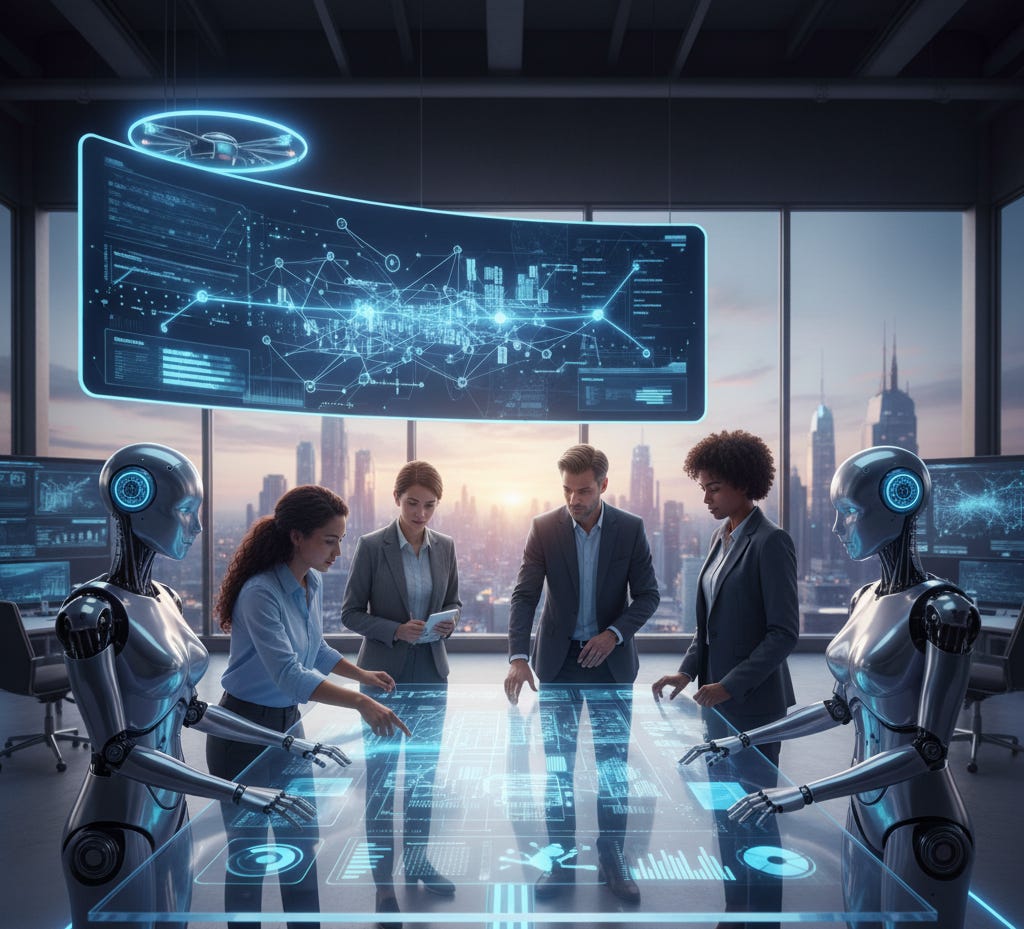
🤖 Blended Human-AI Teams: The Future of Work
The future workforce isn’t man or machine — it’s man with machine.
Hybrid Teams: AI handles data processing and analytics while humans focus on creativity, empathy, and strategy.
Increased Innovation: AI’s ability to process massive data sets empowers teams to innovate faster and make sharper, data-backed decisions.
Leadership Evolution: A new category of leaders — AI workforce managers — is emerging to ensure seamless collaboration between humans and AI.
In industries like finance, marketing, and operations, AI teammates are already redefining performance. See how Expert360.ai’s AI-integrated teams help organizations deploy hybrid work models that scale efficiently and intelligently.
📈 Strategic Implications for Businesses
To stay competitive in this new ecosystem, leaders should:
Invest in Reskilling: Build internal capabilities around AI tools and data literacy.
Adopt AI Integration: Implement systems that enhance human potential, not replace it.
Revise Outsourcing Strategies: Blend AI and offshore teams to balance cost efficiency with innovation.
🧠 Final Thoughts
AI isn’t just a tool for automation — it’s a catalyst for redefining white-collar work. The winning formula lies in human-AI collaboration: humans bring context and creativity, while AI brings speed and scalability.
As Amit Ray, AI Scientist and Author of “Compassionate Artificial Intelligence said, “As more and more artificial intelligence is entering into the world, more and more emotional intelligence must enter into leadership.”
The human factor remains the ultimate differentiator — empathy, creativity, and trust are what turn AI adoption into real business transformation.