
The Rise of Offshore AI Partners: Why Companies Are Going Global—and How to Pick the Right One
Automation wins, failures, and the human–AI balance every company must get right before scaling AI.

The New Offshore Rush — and Why Everyone’s Suddenly “Going Global” (Again)
Remember when offshoring meant sending customer calls halfway across the world?
Now, companies are shipping their intelligence there too.
Every boardroom today sounds the same:
“Can we integrate AI?”
“Should we build it in-house?”
“Or find someone who already knows what the heck they’re doing?”
Welcome to 2025 — where the new corporate status symbol isn’t an in-house data lab, it’s a reliable offshore AI partner who can make your systems smarter without setting your servers on fire.
According to Deloitte, over 60% of global mid-sized firms now rely on offshore AI implementation partners — not to invent AI, but to make it actually useful. Think of it as hiring someone who knows how to install the fancy coffee machine and explain which button makes espresso instead of hot water.
Why the surge? Most companies realize they don’t need to become AI wizards — they just need partners who can connect data, tools, and common sense faster than the next guy. Offshore AI teams bridge that gap beautifully — and more affordably.
Early adopters are already reporting up to 40% lower operating costs and faster delivery of data-heavy work like accounting, marketing, and analytics. Not bad for a partnership that doesn’t even need a desk in your office.
Why Offshore AI Partners Are Having a Moment
Let’s be honest: AI implementation is not for the faint-hearted. There’s hype, there’s jargon, and then there’s the moment you realize your shiny new chatbot doesn’t understand your refund policy.
That’s where offshore AI partners come in — not as coders-for-hire, but as translators between business needs and technical execution. Three reasons companies are going this route:
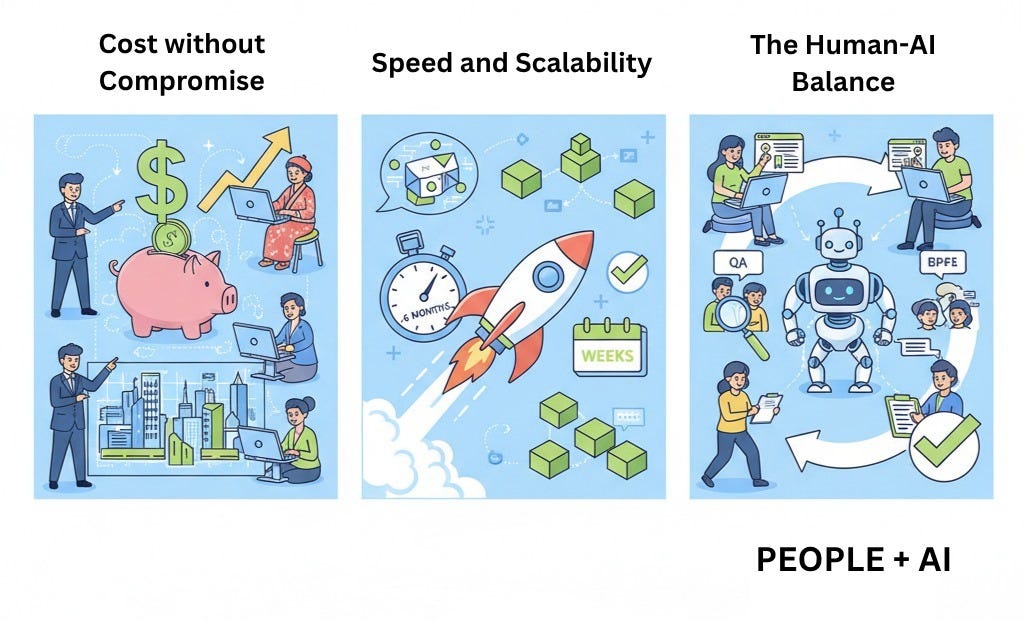
Cost without compromise. Offshore teams can deliver AI-backed process automation at 30–50% less cost than local vendors, thanks to global talent pools.
Speed and scalability. No more 6-month recruitment cycles. Offshore partners scale teams up or down in weeks.
The human-AI balance. The best partners don’t just plug in tools; they integrate human oversight — data analysts, QA specialists, and operations experts — who keep AI honest.
In short, they make sure AI works with people, not instead of them.
What the Future Workforce Looks Like
If the last few years were about “digital transformation,” the next few will be about “digital teamwork.”
AI isn’t replacing employees; it’s reconfiguring how work gets done. Teams will look more like distributed networks — a core in-house group focused on strategy and creativity, supported by offshore AI partners handling execution and data-driven grunt work.
In that sense, the workforce of the future will be a hybrid ecosystem — humans, machines, and offshore specialists operating as one.
The companies getting it right aren’t asking, “What can AI do for us?” but “Who can help us make AI actually work for us?”
Case Study: Klarna’s AI Leap — and the Quiet Rewind
Klarna, the fintech giant, jumped headfirst into automation this year. It made headlines for replacing 700 customer service roles with AI, claiming productivity rose by 25% and costs dropped sharply.
For a while, it looked like a textbook success story — proof that generative AI could run customer support at scale. But then came the backlash.
Users began reporting drops in service quality — slow responses, inaccurate information, and a frustratingly robotic tone. Internally, Klarna realized that even the smartest chatbots struggled with empathy and nuance. Within months, they quietly began rehiring humans to manage complex issues and supervise AI outputs.
The moral? Efficiency isn’t the same as effectiveness. AI can automate routine tasks, but it can’t yet replicate the intuition that builds customer trust.
Practical Lesson: Don’t Marry the Model, Date the Partner
What Klarna learned — and what many others are learning — is that AI is not a one-time project. It’s a continuous relationship that needs monitoring and tuning, and yes, choosing the right AI partner isn’t about replacing humans — it’s about building systems where AI and people work together.
A strong AI partner does three things well:
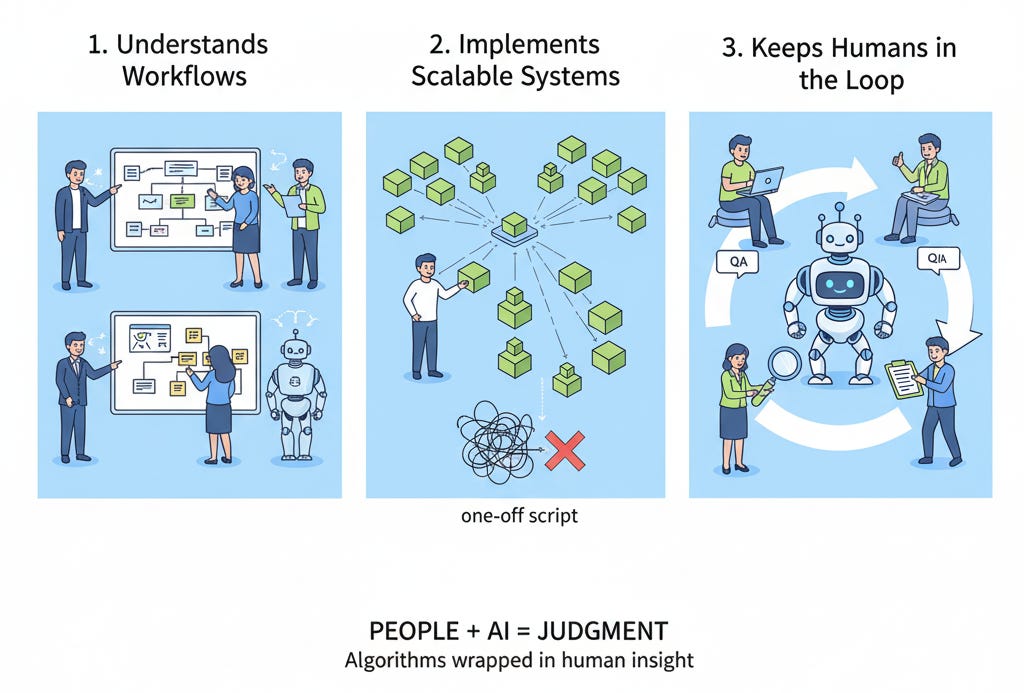
Understands your workflows before deploying tools.
Implements systems that scale — not one-off scripts.
Keeps humans in the loop, ensuring quality and accountability.
In other words, you’re not buying AI — you’re buying judgment wrapped in algorithms.
How to Choose the Right AI Partner (Without Regretting It Later)
If you’re a business leader staring at a dozen shiny AI pitches, here’s a simple filter to apply:
Ask for examples, not demos. A working proof from another client in your industry says more than a dozen PowerPoint slides.
Evaluate how they measure success. Do they talk about productivity, or do they mention accuracy, compliance, and customer experience?
Check their human layer. Who supervises their AI output? If the answer is “no one,” walk away.
The best partners act less like vendors and more like extension teams — experts who understand the pressure of deadlines, customer satisfaction scores, and compliance audits.
The Future Isn’t Fully Automated — It’s Well Orchestrated
It’s tempting to see AI as a silver bullet. But as Klarna (and many quiet imitators) discovered, removing the human layer too fast can backfire.
The real winners of this AI revolution will be those who combine human creativity with AI efficiency, local strategy with offshore execution, and data with discernment.
In short: the companies that treat AI partners not as outsourced vendors, but as co-pilots helping them fly smoother, faster, and safer.
So, before you rush to “AI your business,” ask yourself — are you choosing a tool, or are you choosing a team that knows how to use it right?
Closing Thought
The AI wave isn’t slowing down — but not every company needs to surf it alone. The smartest move might be finding a partner who can build the board and tell you when the tide’s about to turn.
Because in the end, the goal isn’t to automate work — it’s to make work work better.