
The Agentic Shift: How Small Businesses Are Actually Using AI in 2025
A Practical Look at How SMBs Are Using AI to Remove the Admin Tax

From Novelty to Utility
By late 2025, small businesses began noticing something quietly but unmistakably different in their day-to-day operations. Tasks that used to wait for a human—responding to customers, reconciling receipts, reorganizing delivery routes—were now happening automatically in the background. Not perfectly, not dramatically, but reliably enough for owners to say, “AI didn’t just help me today… it actually did the work.”
This marked the end of the “shiny object” phase of 2023–2024 and the beginning of the Agentic Era, where AI is no longer just a content generator but an active employee executing complex, multi-step workflows. Adoption accelerated partly because implementation partners like Expert360.ai helped SMBs move beyond experimentation and into structured, workflow-driven deployment—often cleaning data, mapping processes, and ensuring that AI agents run dependably within real business environments.
Current data indicates that 76% of SMBs are actively using or exploring AI, with daily usage among adopters reaching 63%. The historic enterprise–SMB gap has narrowed to roughly 9–11%, driven by accessible AI agents that provide capabilities once limited to companies with full teams.
The most defining development of 2025 is the shift from Passive AI (asking a chatbot questions) to Autonomous Agents (assigning a bot a job). These agents now handle customer service disputes, negotiate delivery routes, and qualify sales leads with minimal oversight—delivering a reported 2× revenue lift for mature adopters.
1. The 2025 Adoption Landscape
By the Numbers
The adoption curve has steepened significantly as tools became cheaper and more vertical-specific.
91% of AI-enabled SMBs report measurable revenue increases.
Cost of Entry: Micro-firms are deploying meaningful AI agent stacks for as little as $5,000 upfront, while mid-market firms budget ~$1M for custom in-house models.
Labor Impact: Contrary to “replacement” fears, 82% of AI-using SMBs increased their workforce in 2025 to handle the new capacity generated by automation.
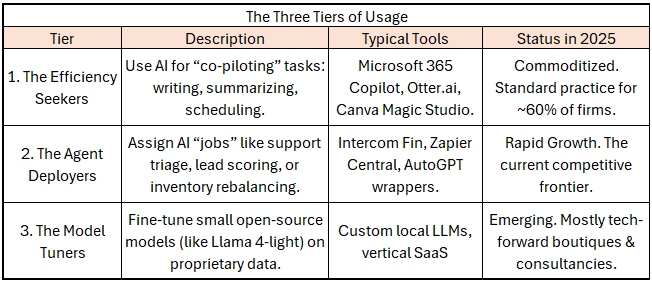
2. Core Functional Shifts: “Authentic” Use Cases
A. Marketing & Sales: The “Always-On” Sales Clerk
In 2023, businesses used AI to write blog posts.
In 2025, they use AI to close deals.
Conversational commerce tools (Rep AI, Tidio) now sit inside WhatsApp or Shopify storefronts. These agents remember past preferences, suggest accessories, and even process refunds without human involvement.
Real-world impact: One Shopify store reported a 14× ROI and conversion rates rising from 3% to 64% on sessions handled by the AI sales agent.
Lead scoring has evolved, too. B2B firms use HubSpot’s AI to “listen” to sales calls, flag missed buying signals, and coach reps in real time—giving small teams the operational muscle of far larger organizations.
B. Operations: The “Boring” AI
Back-office automation is where the highest margins hide.
Inventory agents predict demand, adjust reorder points, and draft purchase orders.
Integrated accounting agents perform continuous reconciliation and flag anomalies (e.g., supplier price hikes).
Logistics agents (OptimoRoute) reorganize a full day’s schedule in seconds when emergencies appear.
These workflow automations don’t feel futuristic—they simply remove friction from everyday business.
C. Specialized Verticals
Legal firms use private instances of Harvey or Casetext to generate first-pass contracts.
Restaurants use conversational “voice AI” at drive-thrus to handle nuanced orders and upsell consistently.
Small teams are producing big-team output without increasing labor hours.
3. The Challenges: It’s Not All Smooth Sailing
1. The “Trust Gap” & Hallucinations
AI can still invent details or misquote policies, requiring Human-in-the-Loop checkpoints on sensitive actions.
2. Implementation Paralysis
With thousands of new tools launching annually, owners struggle to tell durable platforms from disposable wrappers.
Result: 43% of SMEs still lack an adoption plan despite strong interest.
3. Data Readiness
AI is only as strong as the quality of the data fed into it. Many SMBs discover they must spend months organizing their digital assets before AI becomes reliable.
4. Conclusion: The “Centaur” Business Model
The most successful SMBs in 2025 operate as “Centaur” organizations—human judgment on top, AI execution beneath it.
The baker gets to bake again because scheduling runs itself.
The consultant advises again because summaries write themselves.
The founder grows the business instead of drowning in admin.
Final Recommendation:
Start with one high-ROI agentic workflow—customer support or accounts receivable—where value is measurable and immediate. Avoid trying to “AI everything”; precision beats breadth in the early stages.
And for owners who want a guided, low-friction path into this new operating model, Expert360.ai can serve as the implementation partner that helps map your workflows, prepare your data, and deploy reliable agents that deliver real business value from day one.