
The Invisible Ops Debt Slowing Growing Businesses
Your business isn't stalling. Your operations are quietly making sure it does.

There is rarely a visible rupture. Revenue keeps arriving. The team stays busy. Customers persist. Everything reads as functional — until, gradually, it isn’t. Decisions take longer. Outcomes flatten. Execution acquires a kind of drag that no one can precisely locate.
Most founders diagnose this as a growth problem. The more accurate diagnosis is structural: the business is carrying operational debt it never consciously incurred.
What It Is
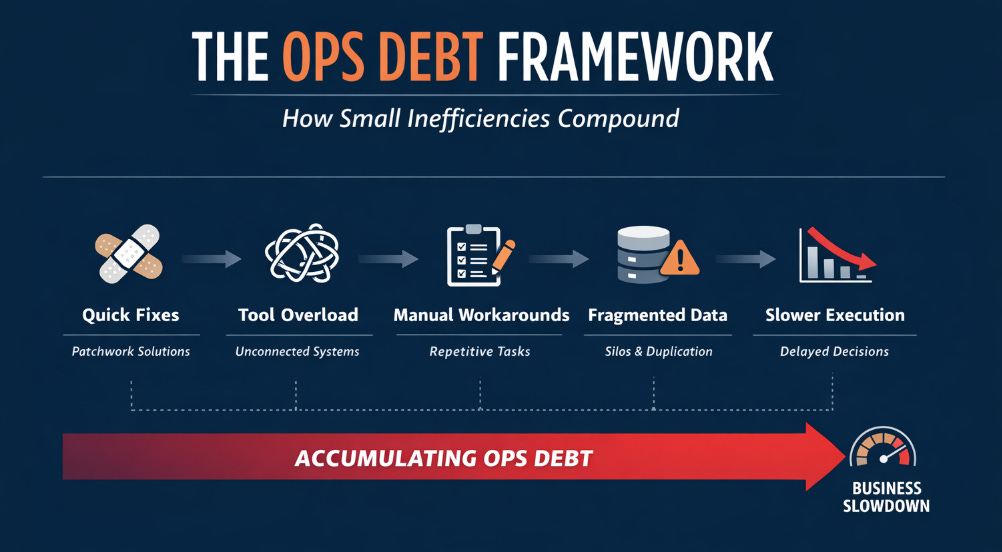
Technical debt has a well-understood definition in software: shortcuts that save time now, compound as liability later. Operational debt follows the same logic, applied to how work actually gets done. It accrues through quick fixes substituted for proper systems, manual effort standing in for structured workflows, and tools adopted without integration into anything coherent.
Individually, none of these feel consequential. One extra spreadsheet. One manual approval step. One disconnected platform. The problem is that small inefficiencies do not remain small — they compound, and they do so without triggering any alarm.
20–30%
of operating costs consumed annually by inefficiency, per McKinsey estimates — structural drag, not incidental noise.
The Numbers
The costs are not minor. Research consistently finds that inefficiency consumes a meaningful share of operating budgets — not as a rounding error, but as a structural condition. The human cost compounds the financial one.

That last figure is worth pausing on. A third of the working week — consumed not by productive effort, but by the friction of badly integrated operations.
How It Builds
The progression is consistent across businesses of different sizes and sectors. Growth creates pressure; pressure generates quick fixes; quick fixes become permanent; new tools are added on top of old ones without integration. Data fragments across systems. No single source of truth emerges. Teams compensate with manual workarounds — spreadsheets, redundant tracking, repeated effort. Decisions slow. Execution acquires the texture of moving through wet concrete.
The business doesn’t fail. It just gets heavier.
"The real hazard is invisibility. Revenue still arrives. The team is still working. Nothing looks broken — until the moment scaling becomes genuinely impossible."
The Broader Cost
Operational debt does not confine its effects to efficiency metrics. It generates execution bottlenecks — work stalls between teams and systems. It produces team burnout, as repetitive manual work displaces meaningful effort. It delays launches and slows deal cycles. And it distorts decision-making: fragmented data produces fragmented insight, which produces decisions made on incomplete information.
The organisation remains busy. It does not remain productive. There is a difference.
The Productive Shift
The companies that resolve this tend to ask a different question. Not “how do we work harder?” but “where is work breaking?” The answer, when found, typically points to processes rather than people, workflows rather than individual tasks, systems rather than isolated tools. Efficiency, properly understood, is not about doing more — it is about removing the unnecessary.
Outsourcing, when applied well, operates on the same principle. Its value is not primarily cost reduction. It is the removal of fragmented execution and repetitive operational load from areas — finance operations, reporting, research, administrative coordination — where accumulation tends to be fastest and friction least visible.
The Point
Growing businesses rarely hit a ceiling because of insufficient demand, talent, or ideas. They hit it because operational friction has quietly accumulated to the point where scaling the business means scaling the dysfunction alongside it. The risk is not that the business slows down. The risk is that operations have been doing that work all along, without anyone noticing.